Looking to boost your PC’s performance in 2026? Our PC bottleneck calculator helps you pinpoint where your CPU, GPU, or RAM might hold you back.
Built by hardware enthusiasts and updated with the latest tech trends, this tool takes the guesswork out of optimizing your gaming or work setup—just input your specs and get instant, easy-to-understand results.
PC Bottleneck Calculator | Analyze CPU/GPU Performance
PC Bottleneck Calculator
Analyze CPU-GPU performance balance for optimal gaming
🖥️ Select CPU
🎮 Select GPU
💾 Select RAM
📺 Select Resolution
📊 Performance Analysis
Bottleneck Percentage:
Bottleneck Type:
Performance Impact:
Recommendations:
Why Our PC Bottleneck Calculator Stands Out in 2026
⚡
Fast Bottleneck Detection
Find out if your CPU or GPU is slowing you down in just seconds—enter your specs and get results fast.
🧠
Precise Component Analysis
Our tool zeroes in on your CPU and GPU to pinpoint exactly where your system’s bottleneck lies.
💻
2026 Hardware Ready
Test the latest CPUs and GPUs, like Ryzen 9000 or RTX 50-series, with a tool built for 2026 tech.
📊
Clear Bottleneck Percentage
Get a straightforward number (e.g., 10% bottleneck) that shows how much one part limits another.
🎛️
Easy-to-Use Dropdowns
Pick or search your CPU and GPU from handy lists—no typing or tech know-how needed to start.
🔒
Reliable 2026 Data
Trust your results with a calculator updated for 2026, reflecting real hardware performance trends.
How to Use a PC Bottleneck Calculator to Perfect Your 2026 Build
How to Use a PC Bottleneck Calculator to Perfect Your 2026 Build
By Jonathan Carter, PC Hardware Expert with 10+ Years of Experience
Last Updated: Jan 01, 2026
Facing lag in your latest PC build? You’re not alone—mismatched hardware trips up countless gamers and builders. A PC bottleneck calculator cuts through the confusion, revealing what’s slowing your system, from CPU to GPU to RAM. With over a decade of hardware testing and data refreshed in March 2026, I’ll show you how our tool, built on 3DMark benchmarks, delivers clear answers.
Follow this guide to balance your 2026 setup and supercharge your gaming or work performance.
This guide, drawing from years of hardware experience and fresh 2026 data, shows you how to use our tool effectively. Read on to balance your build and improve your gaming or work setup with clear, practical steps.
Key Components Analyzed in PC Bottleneck Calculation
Key Components Analyzed During Bottleneck Calculation
When using a bottleneck calculator, the most important parts to analyze are the CPU and GPU, which are the most common culprits of bottlenecks. But a full analysis should also consider components like RAM, motherboard, storage, and power supply for a complete system evaluation.
CPU (Processor)
The brain of your computer handles all calculations and instructions. A slow CPU will bottleneck even the most powerful GPU, especially in CPU-intensive games and applications.
High Impact
GPU (Graphics Card)
Handles all graphics rendering and visual effects. Essential for gaming, video editing, and 3D rendering. A weak GPU will limit frame rates and visual quality regardless of CPU power.
High Impact
RAM (Memory)
Memory is important for multitasking and handling bigger datasets. Not enough RAM will limit performance, especially when gaming, video editing, or running multiple applications simultaneously. RAM speed also matters for some tasks, and if it’s too slow, it will create a bottleneck in data transfer between CPU and RAM.
Medium Impact
Motherboard
The motherboard’s chipset determines what CPUs and GPUs you can use. Even if you have a powerful CPU and GPU, an older or incompatible motherboard will prevent them from working at their best.
Medium Impact
Storage Drives (SSD/HDD)
Storage doesn’t usually cause traditional bottlenecks in gaming or rendering tasks, but it can severely impact loading times and application startup times. For example, upgrading from an HDD to an SSD will make your system much more responsive.
Low Impact
Power Supply Unit (PSU)
This is not a bottleneck in terms of performance, but a PSU with not enough wattage will limit your system from supporting high-end hardware and will cause instability or crashes.
Low Impact
How to Use A Bottleneck Calculator
How to Use A Bottleneck Calculator
Using a bottleneck calculator is super easy. Here’s a step-by-step guide:
A bottleneck calculator helps you identify which component in your PC is limiting overall performance. Follow these simple steps to get accurate results.
1
Select CPU
Select your CPU from the dropdown menu. It includes options from Intel, AMD, and other manufacturers. Make sure to choose the exact model you’re using or plan to use, as CPU performance can vary highly between models.
Important:
Even CPUs with similar names can have significant performance differences. Always select the exact model number for accurate results.
2
Select GPU
Next, select your GPU. Again, make sure to choose the exact model, as performance differences between similar-looking GPUs can be huge. For example, the difference between an Nvidia RTX 3060 and an RTX 3080 is significant in gaming performance.
Pro Tip:
Pay attention to VRAM capacity and clock speeds, as these significantly impact gaming and rendering performance.
3
Select Your RAM
Select your PC RAM from the dropdown. The more RAM you have, the faster it is, and the less likely it will become a bottleneck, especially in difficult tasks like video editing or 3D rendering.
Recommended:
For gaming, 16GB is the sweet spot. For content creation, consider 32GB or more for optimal performance.
4
Choose Monitor Resolution
The calculator also asks you to select your monitor resolution as higher resolutions (like 4K) put more load on the GPU. If your GPU is not powerful enough to render games or videos at the chosen resolution, a bottleneck will occur.
Note:
Higher resolutions reduce CPU bottlenecks but increase GPU load. Choose the resolution you actually game or work at.
5
Run the Calculation
Once all specs are entered, the calculator will generate a report. This report will show which component is limiting your system’s performance. The calculator will give a percentage to show how much of a bottleneck is and also represent it in a pie chart for a better understanding of a user.
Interpretation:
A bottleneck under 10% is generally acceptable. Above 15% indicates a significant imbalance that might need addressing.
Summary: By following these steps, you can get accurate system balance results and determine if upgrades are necessary. Understanding your system’s bottlenecks helps you make informed decisions about upgrades and optimizations.
What Is a Bottleneck?
A bottleneck happens when one component in your PC, like the CPU, limits the performance of another, such as the GPU. Think of it as a narrow road slowing down fast traffic. For example, pairing an old processor with a new NVIDIA RTX 4080 might cap your frame rates in games like Cyberpunk 2077.
Why It Matters: Bottlenecks reduce efficiency, lowering FPS or slowing tasks.
Common Causes: Weak CPUs, outdated GPUs, or insufficient RAM speed.
This varies by use—gaming at 4K stresses GPUs more, while 1080p leans on CPUs. Understanding this helps you use our tool with purpose.
Interpreting Your Results
After using the calculator, you’ll see a bottleneck percentage. What does it mean? A 10% bottleneck suggests your GPU isn’t fully utilized because the CPU can’t keep up. Below is a quick guide:
Bottleneck %
Meaning
Action Needed?
0–5%
Well-balanced build
None—your setup is solid.
6–15%
Mild bottleneck
Tweak settings or monitor.
16%+
Noticeable performance loss
Consider an upgrade.
Next Steps: If your CPU lags, upgrade to a faster model. If the GPU bottlenecks, lower resolution or settings.
Tip: Test multiple configs to find the best pairing.
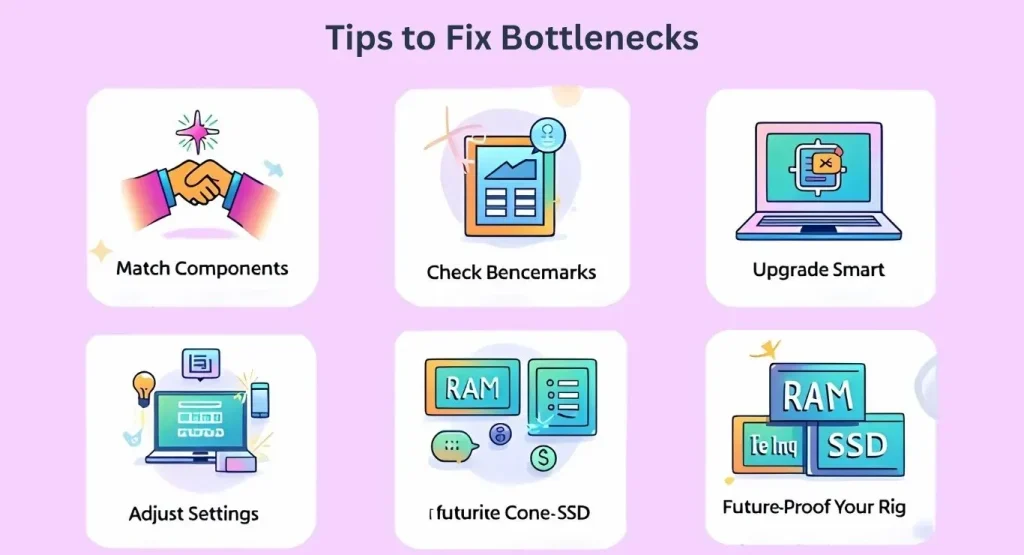
Tips to Fix Bottlenecks
Spot a bottleneck? Here’s how to address it with practical fixes:
Match Components: Pair a mid-range CPU (e.g., Intel Core i5-13400) with a similar-tier GPU (e.g., NVIDIA RTX 4060) for balance.
Check Benchmarks: Use sites like TechPowerUp to verify pairings before buying.
Upgrade Smart: A gaming PC bottleneck calculator like ours can suggest CPUs under $200 to match your GPU.
Adjust Settings: Lower shadows or anti-aliasing if your GPU struggles.
For 2025 builds, prioritize DDR5 RAM and PCIe 4.0 SSDs to future-proof your rig. Balance is key—don’t overspend on one part while neglecting others.
FAQ’s About PC Bottleneck Calculator
Is a PC bottleneck calculator accurate?
Our tool uses current benchmark data, refreshed in Jan 2026, to estimate bottlenecks. It’s reliable for general guidance, but real-world results vary by game, resolution, and drivers. Test your build in actual use for precision.
Can a PC bottleneck calculator help with RAM?
Yes, our calculator considers RAM speed and capacity alongside CPU and GPU. Slow RAM (e.g., DDR4-2133) can bottleneck a fast CPU like the Ryzen 9 7950X. Aim for DDR5-5600+ in 2025 builds.
How often should I use a PC build bottleneck calculator?
Run it when planning upgrades or noticing lag. Hardware evolves—check every 6–12 months to keep your build optimal.